La Roche Posay Melt in Milk Sunscreen Review 2026: Worth It?
Sunscreen shopping feels like a gamble. You buy a bottle, you hope it absorbs, and you pray it does not turn your face into a greasy mirror.
The La Roche Posay Anthelios Melt in Milk Sunscreen has sat at the top of “best body sunscreen” lists for years. It is the brand’s number one seller. Dermatologists keep recommending it. Beauty editors keep testing it.
I spent weeks using this sunscreen on my face, arms, chest, and legs. I tested it on cloudy days, at the beach, and during sweaty morning runs. This review covers the good, the bad, and the parts nobody mentions in the glossy ads.
Key Takeaways
- The texture is the main selling point. This sunscreen spreads like a thin body lotion and sinks in within a minute. It does not sit on top of your skin like a thick paste. Most testers report full absorption in under sixty seconds.
- Protection levels are genuinely high. You get Broad Spectrum SPF 60 with avobenzone, homosalate, octisalate, and octocrylene. The formula also includes Cell Ox Shield antioxidant technology, which adds vitamin E to help fight free radical damage. Water resistance lasts up to eighty minutes.
- Sensitive skin tolerates it well. The formula skips oxybenzone, octinoxate, and added fragrance in the current US version. It carries allergy tested and non comedogenic claims. People using retinoids or acne treatments often name this as their safest pick.
- It stings eyes. This is the single most repeated complaint across user reviews. The formula migrates with sweat and burns if it reaches your eyes. Keep it away from your brow line.
- The finish is glowy, not matte. Oily skin types will likely need powder on top. Anyone chasing a flat matte look should shop elsewhere.
- The price hurts. A 5 ounce tube sits near thirty dollars. Body sunscreen gets used fast, so the cost adds up quickly.
What Is La Roche Posay Anthelios Melt in Milk Sunscreen?

- Multi-award winning body sunscreen with advanced protection in a fast-absorbing, velvety texture that leaves skin hydrated and smooth. Broad Spectrum SPF 60
- Allure 2022 Best of Beauty Award Winner. Water resistant (80 minutes)

Last update on 2026-10-05 / Affiliate links / Images from Amazon Product Advertising API Some of the links on this website are affiliate links, which means that at no additional cost to you, I earn a commission if you click through and make a purchase. I only recommend products and services that I believe will add value to my readers. Thank you for your support!
This is a broad spectrum chemical sunscreen built for both face and body. La Roche Posay launched it as part of the Anthelios sun care range, which the brand developed with dermatologists for sun sensitive skin. The “melt in milk” name describes the texture. The lotion starts thick in the tube and thins out as you rub it in.
The US version delivers SPF 60 protection against UVB rays and broad spectrum coverage against UVA rays. UVA causes aging. UVB causes burning. You need both covered.
La Roche Posay reports that 94 percent of testers said it absorbed quickly and 90 percent said their skin felt moisturized afterward. The formula is oil free, oxybenzone free, and suitable for adults and children aged three and up. It comes in 3 ounce and 5 ounce tubes, plus a larger family size.
Unboxing Experience and First Impressions
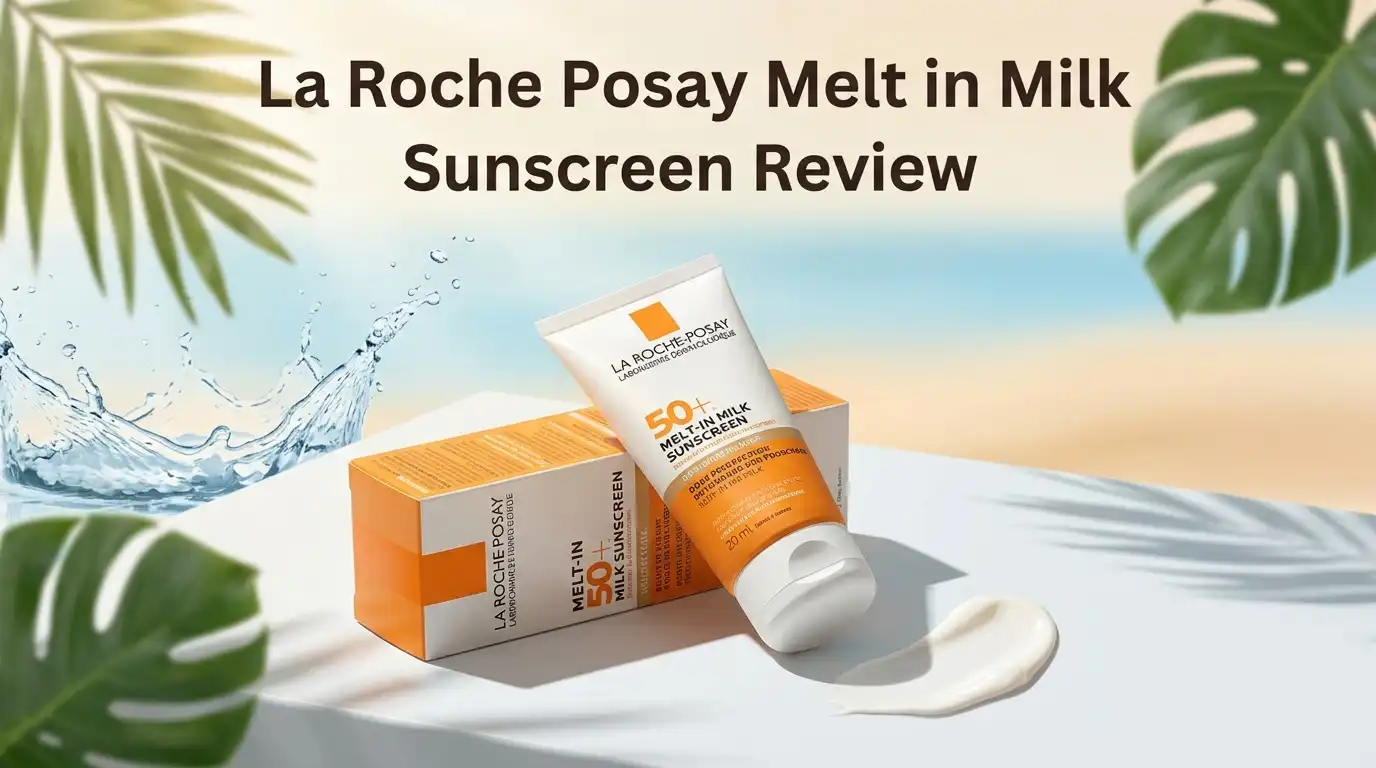
The packaging arrives in a simple cardboard box with the familiar La Roche Posay blue and white design. No plastic shell. No wasted material. Inside sits a glossy squeeze tube with a flip top cap.
The cap clicks shut firmly. I tossed the tube in a beach bag for a full week and found zero leaks. That matters more than it sounds.
One warning about the tube. The surface is slick and glossy. Handle it with wet hands and it will shoot across your bathroom like a bar of soap. I dropped mine twice in the first week.
The first squeeze releases a thin white lotion. It looks like body milk, not sunscreen paste. The consistency surprised me because most SPF 60 products feel heavier than this. There is a faint sunscreen scent on first application. The smell fades within a few minutes.
Key Ingredients and How They Work
The active ingredients do the heavy lifting. Avobenzone at 3 percent handles UVA rays. Homosalate at 10 percent, octisalate at 5 percent, and octocrylene at 7 percent cover UVB rays and stabilize the avobenzone. Avobenzone breaks down in sunlight without a stabilizer, so octocrylene plays a real role here.
The supporting cast matters too. Glycerin pulls water into the skin and keeps it hydrated. Tocopherol, which is vitamin E, acts as the antioxidant in the Cell Ox Shield blend. Cassia alata leaf extract adds a soothing effect and helps protect against free radicals.
The formula contains no oxybenzone and no octinoxate. It also skips added fragrance in the current US version, though some users still detect a mild chemical sunscreen smell. Dimethicone and silica give the lotion its smooth slip.
Top 3 Alternative for La Roche Posay Melt in Milk Sunscreen

- HSA ELIGIBLE/FSA ELIGIBLE SUNSCREEN: Includes one 5 fluid ounce tube of Eucerin Sun Advanced Hydration Sunscreen Lotion SPF 50
- 5 AOX SHIELD FORMULA: This Eucerin sunscreen SPF 50 is enriched with 5 antioxidants (Glycyrrhetinic Acid, Licochalcone A, Vitamin E, Vitamin C, Oxynex ST) and Hyaluronic Acid to help hydrate skin(1)
Last update on 2026-10-09 / Affiliate links / Images from Amazon Product Advertising API Some of the links on this website are affiliate links, which means that at no additional cost to you, I earn a commission if you click through and make a purchase. I only recommend products and services that I believe will add value to my readers. Thank you for your support!
Eucerin Sun Advanced Hydration Sunscreen Lotion SPF 50

- [ BROAD SPECTRUM SUNSCREEN FOR BODY SPF 50 ] 100% Mineral-based sunscreen, also known as a physical sunscreen, reflects UVA/UVB rays to help protect the skin. Formulated with titanium dioxide and zinc oxide sunscreen. Developed with dermatologists.
- [ MINERAL SUNSCREEN APPLICATION ] Physical sunscreens often leave a white cast when applied in thick layers. For best results, apply sunscreen evenly to the entire body in thin layers and thoroughly massage into skin. Suitable sunscreen for kids & adults.
Last update on 2026-07-14 / Affiliate links / Images from Amazon Product Advertising API Some of the links on this website are affiliate links, which means that at no additional cost to you, I earn a commission if you click through and make a purchase. I only recommend products and services that I believe will add value to my readers. Thank you for your support!
CeraVe Hydrating Mineral Sunscreen SPF 50 Body

- POWERFUL SPF 55 BROAD SPECTRUM PROTECTION: Ultra Sheer Dry-Touch SPF 55 delivers high-performance UVA/UVB defense with Helioplex Technology, helping protect skin from sunburn while supporting a healthy-looking, radiant complexion.
- LIGHTWEIGHT, NON-GREASY & FAST ABSORBING: Dry-Touch technology creates a clean, ultra-light, non-greasy feel that absorbs quickly for an invisible finish. This lightweight sunscreen layers easily under makeup and leaves no white cast.
Last update on 2026-10-09 / Affiliate links / Images from Amazon Product Advertising API Some of the links on this website are affiliate links, which means that at no additional cost to you, I earn a commission if you click through and make a purchase. I only recommend products and services that I believe will add value to my readers. Thank you for your support!
Neutrogena Ultra Sheer Dry Touch Sunscreen Lotion SPF 70
Texture, Finish and How It Feels on Skin
This is where the product earns its reputation. The lotion spreads with almost no resistance. One pump sized amount covers a full forearm. You do not need to press or drag.
Absorption takes roughly thirty to sixty seconds on body skin. On face skin it takes slightly longer, maybe ninety seconds. There is no sticky film afterward.
The finish leans glowy. Your skin looks slightly luminous and healthy, almost like you applied a light body oil without the grease. Dry skin types will love this. Oily skin types may not.
I tested it under a t shirt twenty minutes after application. No transfer. No white marks on fabric.
Reapplication works well too. The second layer does not pill or ball up, which is a common failure point with silicone heavy sunscreens. That alone saved me frustration on beach days.
Sun Protection Performance in Real Life
Lab numbers mean little if a sunscreen fails outdoors. I wore this during a four hour stretch at the beach in direct sun and reapplied every two hours.
No burn. Not on my shoulders, not on the tops of my feet, not on my nose. My skin tone burns easily, so this was a real test.
I also wore it during morning runs when sweat ran freely. The product held up for the full eighty minute water resistance window. After that, it needed reapplication like every other sunscreen on the market.
One honest note. SPF 60 does not mean you can skip reapplication. The jump from SPF 30 to SPF 60 adds only a small percentage of extra UVB filtering. The real benefit is a buffer for under application, since most people apply far less sunscreen than the amount used in lab testing.
How It Performs on Face Versus Body
The brand markets this for both face and body. That claim holds up with one caveat.
On the body, it works beautifully. It spreads far, absorbs fast, and leaves skin soft. A 5 ounce tube covers maybe six to eight full body applications if you use the recommended amount.
On the face, results depend on your skin type. Dry and normal skin types get a comfortable, hydrated finish. The product sits well under light makeup and acts almost like a smoothing primer.
Oily skin types report a different story. The glowy finish tips into shiny by midday. You will likely need a setting powder or blotting paper.
Acne prone users have mixed experiences. The formula is labeled non comedogenic, and many people with reactive skin tolerate it. Others report congestion after a week of daily facial use.
White Cast Test Across Skin Tones
Chemical sunscreens usually avoid white cast problems, and this one mostly does.
On light skin, there is no visible cast at all once the product absorbs. On medium skin tones around Fitzpatrick III and IV, some users report a very slight cast that fades within a few minutes. It is noticeable in direct bathroom lighting but not in daily life.
On deeper skin tones, reports lean positive. The lotion blends in without the ashy grey tint that mineral sunscreens leave behind. La Roche Posay states the formula does not leave a white cast on any skin tone.
My own experience matched this. The only place I saw white residue was along my hairline when I rushed the blending. Thirty extra seconds of rubbing solved it completely.
Water Resistance and Sweat Performance
The label states water resistance up to eighty minutes. That is the highest rating the FDA allows for a sunscreen in the United States.
I swam for forty minutes in a pool and the product stayed put. No burning, no slick runoff. After towel drying, I reapplied anyway, because towels remove sunscreen regardless of water resistance claims.
Sweat is a tougher test. During hot runs, the product migrated toward my eyes. This happened consistently and it became the biggest problem I had with the formula.
Once it reaches your eyes, it stings. Not an unbearable sting, but enough to make you stop and rinse. A reader trick that works well is leaving your eyebrows sunscreen free, since brows act as a barrier that catches the runoff.
For high sweat activities, consider a stick sunscreen for the face and save this one for your body.
Pros and Cons
Pros
- Spreads and absorbs faster than almost any SPF 60 lotion at this price point
- Broad Spectrum SPF 60 with stabilized avobenzone for reliable UVA coverage
- Water resistant for the full eighty minute maximum rating
- Free from oxybenzone, octinoxate, parabens, and added fragrance
- Leaves skin hydrated thanks to glycerin and the soothing plant extract
- Minimal to no white cast across most skin tones
- Reapplies cleanly without pilling over the first layer
- Safe for children aged three and above, which makes it a family friendly option
Cons
- Stings badly if it reaches your eyes, especially during sweating
- Expensive compared with drugstore sunscreens offering similar SPF
- Glowy finish reads as shiny on oily skin by midday
- Faint chemical sunscreen smell that some users dislike
- The glossy tube slips out of wet hands easily
- A few users report clogged pores after extended daily face use
- Uses older US approved filters rather than newer European options
What This Sunscreen Does Not Do Well
Honest reviews name the failures, so here they are.
It is not a matte sunscreen. If you have oily skin and want a shine free finish, this product will disappoint you every single time. No amount of blending changes that.
It is not eye safe. The eye sting problem is real and widespread. People with sensitive eyes should avoid using it close to the lash line.
It is not budget friendly. Body sunscreen gets used in large amounts. At current prices, a heavy user could go through a tube every two weeks during summer.
It also does not offer the lightweight elegance of Asian or European sunscreens. Reviewers who have tried Japanese or Korean formulas often find this one noticeably heavier. US regulations limit which filters brands can use, and that gap shows.
Finally, it does not tint, blur, or correct tone. This is pure sun protection.
SPF 60 Versus SPF 100: Which One Should You Buy?

- This travel size sunscreen is non-sealed
- SPF 100 sunscreen for face and body, specifically formulated to help protect skin that burns easily.
Last update on 2026-06-07 / Affiliate links / Images from Amazon Product Advertising API Some of the links on this website are affiliate links, which means that at no additional cost to you, I earn a commission if you click through and make a purchase. I only recommend products and services that I believe will add value to my readers. Thank you for your support!
La Roche Posay sells the Melt in Milk formula in both SPF 60 and SPF 100. The difference is smaller than the numbers suggest.
SPF 60 filters roughly 98.3 percent of UVB rays. SPF 100 filters roughly 99 percent. That gap is under one percentage point.
So why buy SPF 100? Because almost nobody applies enough sunscreen. Studies consistently show people use between a quarter and half of the tested amount. A higher starting SPF gives you a cushion for that shortfall.
The SPF 100 version feels slightly thicker and takes a few seconds longer to absorb. Some users also report a stronger scent with that formula.
My take: choose SPF 60 for daily use and SPF 100 for beach days, high altitude trips, or if you take photosensitizing medication. Both use the same antioxidant technology.
Who Should Buy This Sunscreen?
This product suits specific people very well.
Buy it if you have dry, normal, or combination skin. The hydrating finish works in your favor rather than against you.
Buy it if you have sensitive or reactive skin. The fragrance free, oxybenzone free formula causes fewer reactions than most chemical sunscreens on US shelves.
Buy it if you want one product for face and body. Carrying a single tube simplifies travel and beach trips.
Buy it if you use retinoids, acids, or acne medication. Sun protection becomes non negotiable with those treatments, and this formula plays nicely with compromised skin barriers.
Skip it if you have very oily skin, if sunscreen in your eyes ruins your day, or if your budget is tight. A drugstore alternative will serve you better in those cases.
Price, Sizes and Value for Money
La Roche Posay sells this sunscreen in a few sizes. The 3 ounce tube suits travel and face only use. The 5 ounce tube is the standard choice. There is also a larger 150 millilitre option listed on the brand site.
The 5 ounce tube typically retails near thirty dollars, though sales frequently drop it closer to twenty two. Amazon pricing shifts often, so checking before you buy pays off.
Is it worth it? For face use, yes. A 3 ounce tube lasts weeks and the formula quality justifies the premium.
For full body use, the math gets harder. You could buy three bottles of a solid drugstore sunscreen for the same money.
My compromise: use this one on the face and visible areas, and use a cheaper lotion for legs and back.
How to Apply It for Best Results
Application technique changes your results more than most people realize.
Use enough product. For the face and neck, that means roughly a quarter teaspoon. For the full body, you need about one ounce, which is a shot glass worth.
Apply fifteen minutes before sun exposure. Chemical filters need time to form an even film on the skin.
Warm it between your palms first. The lotion spreads further and blends faster when slightly warmed.
Skip your eyebrows and the immediate under eye area if you plan to sweat. This single change prevented most of my eye sting problems.
Reapply every two hours, and immediately after swimming or towel drying. Set a phone timer if you tend to forget. Shake the tube before each use, since the formula can separate slightly after sitting.
Final Verdict
The La Roche Posay Anthelios Melt in Milk Sunscreen earns its reputation, mostly.
The texture is genuinely excellent. It absorbs faster than nearly any SPF 60 lotion I have tested, it leaves skin hydrated, and it causes almost no white cast. Sensitive skin types will find it gentler than most US chemical sunscreens.
But it has two real flaws. The eye sting is persistent and annoying. The price is high for a product you should be using generously every single day.
My rating sits at 4.3 out of 5. It is an easy recommendation for dry and sensitive skin, a conditional recommendation for oily skin, and a tough sell for anyone watching their spending.
Buy the 3 ounce tube first. Test it for two weeks. If your skin agrees with it, upgrade to the larger size.
Frequently Asked Questions
Does La Roche Posay Melt in Milk Sunscreen leave a white cast?
No, not in most cases. The chemical filter formula absorbs clear on light, medium, and deep skin tones. Some users with medium tones notice a brief light cast that disappears within a few minutes of blending. Rubbing it in fully along the hairline prevents any residue.
Is this sunscreen safe for the face?
Yes. The product is labeled for both face and body, is non comedogenic, and is allergy tested. Dry and sensitive skin types do best with it. Oily skin types may find the glowy finish too shiny and should set it with powder.
Can children use it?
The formula is approved for adults and children aged three years and older. For babies under six months, pediatricians recommend shade and protective clothing instead of sunscreen. Always patch test on a small area of a child’s skin first.
How long does one tube last?
A 3 ounce tube used on the face alone lasts roughly four to six weeks with daily application. A 5 ounce tube used on the full body lasts around five to eight applications if you use the recommended amount. Heavy summer users go through tubes quickly.
Does it clog pores?
The formula carries a non comedogenic label and most users report no congestion. A minority of acne prone users do report clogged pores after weeks of daily facial use. Patch test for a week before committing to full face application.
Is SPF 60 enough for the beach?
Yes, SPF 60 provides strong protection when applied correctly and reapplied every two hours. The bigger risk is under application rather than the SPF number. Pair it with a hat, sunglasses, and shade for complete protection during long beach days.
Why does it sting my eyes?
Chemical UV filters like avobenzone and octocrylene irritate the eye surface on contact. Sweat carries the product down from your forehead into your eyes. Leaving your eyebrows free of sunscreen creates a natural barrier that catches most of the runoff.

Hi, I’m Hannah Foster, a tattoo trend expert and blogger. I’m passionate about body art and love sharing my knowledge and inspiration with others. On Glamour Hub, I’ll be sharing my favorite tattoo designs, trends, and tips. Follow me on Pinterest @Glamourhubblog to stay up-to-date on the latest in tattoo fashion.